Gender Pay Gap
What is the gender pay gap?
There is current UK legislation on ‘gender pay gap’ and ‘equal pay’, both of which seek to highlight and address disparity of pay women receive in the workplace in the UK.
- The gender pay gap is a measure of the difference in the average earnings of men and women regardless of the nature of their work across an organisation. It is intended to illustrate where there is a greater proportion of men who may on average hold more senior positions with higher pay. The gender pay gap is expressed as a percentage of men’s earnings on a ‘snapshot date’ which is 5 April each year, and is reported on a mean and a median basis. Larger percentage variations are normally an indicator that more women are employed in lower paid grades and there are more men in the more senior grades.
- Equal pay legislation deals with any pay differences between men and women within an organisation who carry out the same jobs, similar jobs or work of equal value. We analyse and report to the Board’s Remuneration Committee on equal pay every six months and we do not have an equal pay gap.
Our Gender Pay Gap on 5 April 2025
Management consulting, like many professional services sectors, faces a structural challenge in attracting and retaining women at all stages of their careers. In particular, a smaller proportion of women pursue long-term careers in consulting, resulting in a more limited pool of female talent at senior levels.
At Efficio, we recognise that addressing this imbalance requires a long-term and deliberate approach. We are focused on building a stronger and more sustainable pipeline of female talent by investing in the development of our own future leaders, alongside targeted efforts to attract experienced female candidates.
Over recent years, we have taken a deliberate and sustained approach to increasing the proportion of women across all levels of the organisation, with a particular focus on early career recruitment, alongside targeted efforts to attract experienced female candidates. This has resulted in strong growth in female representation at more junior levels, with the intention of developing this cohort into our future managers and senior leaders over the next 3–4 years.
In the short term, this approach results in a workforce structure where female representation is higher in more junior roles. While this can contribute to the gender pay gap, it reflects a long-term investment in building a more balanced and sustainable leadership pipeline.
Gender pay gap data
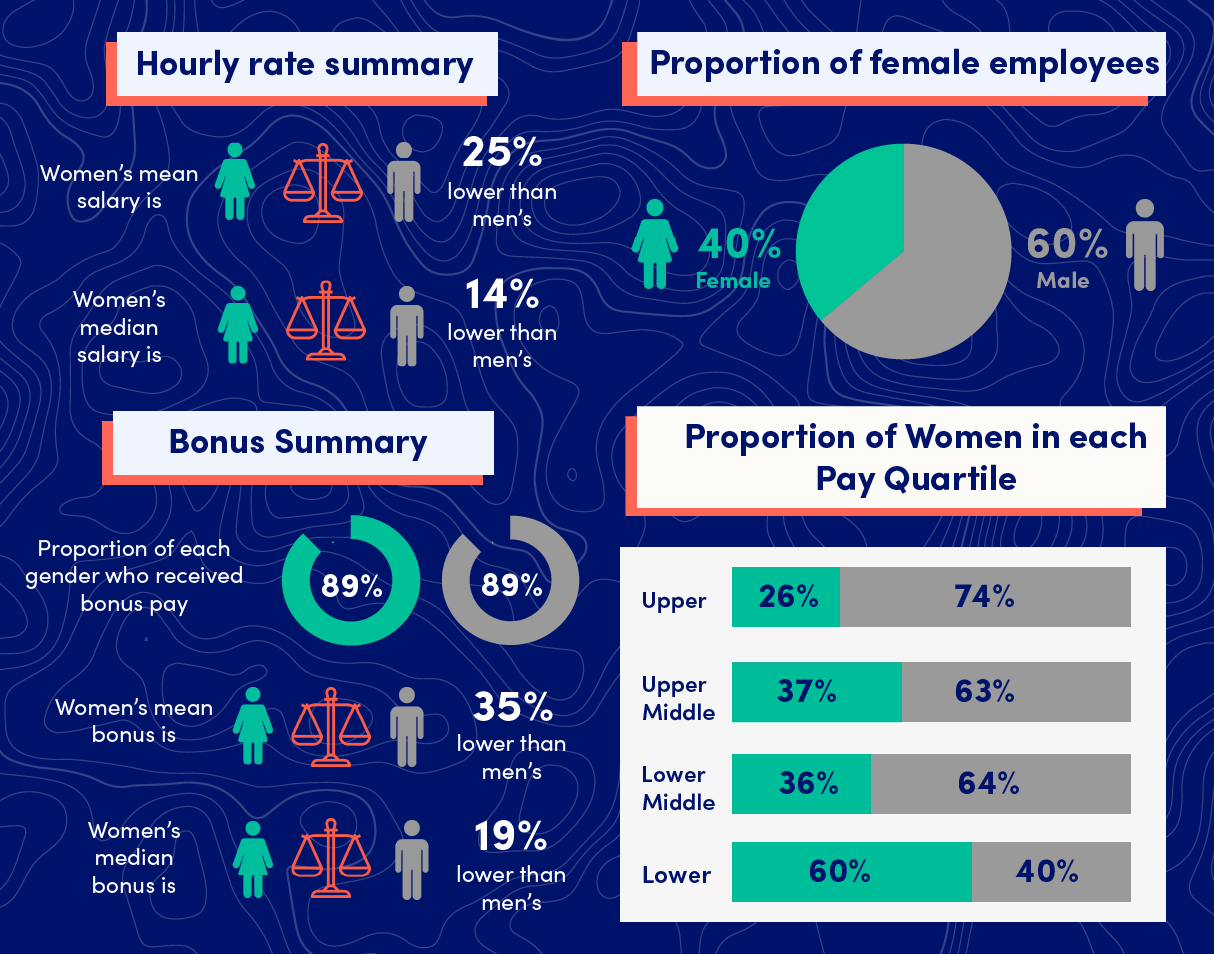
As of April 2025, women’s median hourly pay is 14% lower than men’s, and the median bonus gap is 19%.
Women’s mean hourly pay is 25% lower than men’s, and the mean bonus gap is 35%, both of which have improved compared to the previous year (40% and 61%, respectively).
We have seen a gradual increase in female representation in the upper pay quartile, alongside a more significant increase in the lower quartile. This reflects our continued focus on building a strong pipeline of future female talent, with increased representation at more junior levels expected to support improved balance at senior levels over time.
Overall, while our gender pay gap continues to be driven by the lower proportion of women in senior roles, the improvements seen over the past year reflect progress in both representation and a more balanced distribution of pay and bonus outcomes.
Activities and plans
Over the past year, we have increased the proportion of women in our UK business from 38% to 40%. At the same time, the number of women in our three most senior grades (Principal, Director and Vice President) has decreased from 20 to 18, representing a 10% reduction.
While this reflects the natural variability that can occur in a growing organisation, it reinforces the importance of maintaining a strong and sustained focus on progression into senior leadership roles.
We are taking a targeted and structured approach to improving gender balance across the organisation, focusing on recruitment, progression and retention.
We continue to strengthen our recruitment efforts to improve gender balance across all levels, with a particular focus on attracting and building a strong pipeline of female talent at early career stages, while also seeking to increase representation at more senior levels.
Alongside this, we are investing in progression through tailored career development and accelerated development initiatives, aimed at supporting women to advance into leadership roles over time.
We are also actively promoting and supporting employee-led initiatives, including the Female Mentorship Programme and Women’s Network. These initiatives support recruitment, progression and retention by enhancing our ability to attract female talent, providing mentoring and peer support, and enabling women to build networks, confidence and skills at key career transition points.
Together, these actions are designed to address the structural challenges that contribute to the gender pay gap and to support the development of a more balanced and sustainable leadership pipeline over time.
Our commitment
We recognise that addressing the gender pay gap requires sustained effort over time, particularly in improving representation at senior levels.
The Board remains committed to reducing our gender pay gap and building a more balanced organisation where progression and reward outcomes are equitable for all.